
Dawn Hunter's South Carolina Sunshine


Studio Visit
A PHOTO ESSAY AND "TUMBLR" PAGE FEATURING PAST, PRESENT AND FUTURE PROJECTS BY SOUTH CAROLINIAN ARTIST, DAWN HUNTER.
Table of Contents Icons
Currently highlightin work inspired by Santiago Ramón y Cajal, exploring neuroscience through drawing, painting, and archival research.

Studio Practice + Teaching Practice
Studio Visit offers a look inside my creative practice as both an artist and educator. The projects collected here move between my personal artwork, research, exhibitions, sketchbooks, and works in progress, as well as selected teaching portfolios that document the assignments, processes, and student work developed in my studio courses.
For me, these two areas of practice are closely connected. The same interests in observation, experimentation, visual perception, interpretation, and creative problem-solving that shape my artwork also inform the way I teach. The portfolios below provide different points of entry into that ongoing exchange—some lead into my studio and research projects, while others open the door to my classroom and the creative processes I develop with students.
I especially like “some lead into my studio…while others open the door to my classroom” for this page. It makes the repeater structure understandable without sounding like website instructions, and it fits the idea of a Studio Visit very naturally.
.jpg)
Personal Artwork: This painting has developed over time and remains a means of holding together the memory, experience and influence that it has embodied from the start. It was a painting about loss which has become a very complex, deeply layered and multi-layered work.
The physical marks on the painting’s surface evolve from early explorations into marks and color, to more assured and complex uses of all of these in order to paint personal memories and the influences of earlier art. Portraits, shards and other symbols appear in the painting. Often they have been developed from a variety of sources and then reworked and recombined in non-linear fashion and, on occasions, returned to the surface of the painting at a later date in order to revisit an earlier experience or to reflect upon it.

Personal Artwork: The Studio Visit above is a drawing of neuroscientist Pasko Rakic by Dawn Hunter at the Cajal Club Social at the Society for Neuroscience meeting in San Diego. Dr. Rakic, one of the leading researchers on the developing cerebral cortex, has maintained contact with the Club over the years. He was invited to join the Club by founder Wendell Krieg. In this Studio Visit Hunter drew the neuroscientist while Rakic discussed his early interest in art and how the drawings of cortical structures by Santiago Ramón y Cajal influenced his decision to become a scientist.
The drawing shows the moment of conversation between the artist and the scientist, totally absorbed by what is going on while the artist is completing the work in one sitting. The drawing is more than a portrait of Rakic. It shows the artist’s position within the tradition of art and neuroscience and how his observation, memory and influence of Cajal’s visual approach to neuroscience is being extended to the contemporary scientific and artistic practice.

Personal Artwork: This studio visit highlights a recent sketchbook series made on a trip to Atlanta, where I carried my book everywhere and drew from life. At the High Museum of Art I made studies after two large acrylics by the celebrated South Korean painter Kim Chong Hak's works Autumn and Pandemonium. Responding to Kim’s luminous florals and mountain imagery, my drawings explore how line, rhythm, and simplified shape can translate the vitality of another artist’s vision while remaining unmistakably my own.
Beyond the galleries, I turned to the people of Midtown. At the bar Politan Row, Colony Square, I worked rapidly, building pages of caricature-like portraits of the guests. One encounter became a sustained portrait: Kree, a young pregnant nursing student on a staycation with her boyfriend. The drawing slows the pace of the environment around her, describing calm poise amid the crowd.

Personal Artwork: I had the honor of designing the Krieg Lifetime Achievement Awards for the Cajal Club two years in a row—celebrating Dr. Charles E. Ribak in 2023 and Dr. Larry Swanson in 2024. Each award features two historic certificates, one signed by Santiago Ramón y Cajal and the other by Wendell Krieg, founder of the Cajal Club. Drawing on their shared legacy as neuroanatomical illustrators, I approached the project as a visual homage and narrative translation—combining historic symbolism, hand-rendered elements, and custom presentation cases to reflect the scientific and personal contributions of each recipient.

Personal Artwork: Welcome to the online portfolio collection of Dawn Hunter, an Associate Professor at USC, a Fulbright Scholar, and a passionate, prolific visual artist. With two decades under her belt, exhibiting her art at leading educational institutions and professional galleries, she's made a profound mark in the art world.
In an effort to provide an effortless browsing experience and ensure her diverse portfolio themes are accessible, Dawn has curated a collection of specialized websites, each dedicated to a distinct theme and content. Consider this your gateway to a vast array of Dawn's creative endeavors and portfolios, each a testament to her extensive career and artistic evolution.

Personal Artwork: Step into the world of Cajal's Scientific Drawings and Plein Air Landscape paintings of locations where he lived. Cajal's remarkable scientific illustrations are a testament to his keen observation and remarkable talent for visually conveying complex concepts. Inspired by Cajal's legacy, Dawn embarks on a creative journey by painting landscapes from his birthplace, interweaving them with rendered neuron imagery. Through this artistic fusion, she aims to capture the environment that fueled his scientific pursuits visually.

Personal Artwork: "I am thrilled to announce that my artwork, The Darcy Inventory, has been chosen for this prestigious exhibition. In addition to preparing for the showcase, I've been keeping busy creating captivating Instagram Reels. The Darcy Inventory is a thought-provoking portrait installation I crafted in October. It explores, through visual art, profound themes such as race, identity, societal norms, and the intricate dynamics of our modern culture's daughter/mother relationship. Join me on this artistic journey and witness the power of visual storytelling at ArtFields!" ~Dawn Hunter

Personal Artwork: Unleash your imagination and explore the captivating connection between dancers and the intricate world of cells. Picture them gracefully moving at the center of the cell, akin to the nucleus—the very command center that orchestrates growth, division, and gene expression. Prepare to be enthralled by Dawn's latest painting series, a fusion of the mesmerizing "Cell Block Tango" dance and Santiago Ramón y Cajal's legendary neuron imagery. Through a blend of art and science, these figurative works unravel the narrative of a cell's function, weaving together the beauty of movement and the intricate workings of cellular life. Join this artistic journey where art and science harmoniously intertwine.

Personal Artwork: Immerse yourself in the world of Facetober, created by critically acclaimed illustrator Charly Clements. "I use the opportunity of this social media challenge to focus on the sub-theme of my daughter, Darcy. I experimented with portraiture, color, and patterns to create a warm and intimate atmosphere. Among this series, Darcy's favorite portrait, featuring blue braids and gold hoop earrings, exudes sophistication and mystery. These expressive images depict our evolving relationship, showcasing our collaboration and the joy we share." ~Dawn Hunter

Personal Artwork: Embark on a journey of artistic discovery with SciArtSeptember, an enriching social media event in which Dawn has had the pleasure of participating in for the second time. What truly excites her is the opportunity to respond to thought-provoking prompts through her artwork, exploring various topics within science and art. This event catalyzes connecting with other talented artists, providing a platform to learn and grow together. She is grateful to Liz Butler (@liz_lagomorph) and Glendon Mellow (@FlyingTrilobite) for creating and hosting this annual SciArtSeptember initiative, fostering a vibrant community of creative minds.

Personal Artwork: Welcome to the Summertime Drawing Board of Rodin's artwork! During this summer, Dawn's artistic focus revolved around historical subjects such as the Rodin exhibition at the Columbia Museum of Art and the picturesque scenes at the Riverbanks Zoo, which inspired her Plein air sketches. In a fusion of these experiences, her studio became a hub of creativity. This photo essay showcases a glimpse of the various artistic processes involved, including drawings of Rodin statues completed in Madrid (distinguished by an orange background) and her CMA Rodin drawings featuring either white or yellow backgrounds. Rather than simply a sketchbook, she prefers to refer to this collection as a "drawing board." Back in the studio, she had the opportunity to develop these artworks further, exploring new dimensions and possibilities.

Personal Artwork: "I am thrilled to share that my artwork, "Dueling Cajals," received an Honorable Mention prize in the prestigious 2022 Art of Neuroscience competition out of the Netherlands. The jury was struck by this submission, which uniquely explores the history of neuroscience. The piece weaves together diverse periods of time from Cajal's life, emphasizing the cultural and historical influences on scientific image-making. The jury appreciated the meticulous research into the sources that influenced Cajal and recognized the artwork as a potent reminder for neuroscientists to acknowledge and understand the impact of history on their work." ~Dawn Hunter

Personal Artwork: "I am honored and proud to announce my election to the esteemed Cajal Club Board of Directors. Words cannot express my gratitude for the opportunity bestowed upon me to create their new website. The transition from July to August was filled with hard work, collaboration, and invaluable feedback from renowned Neuroscientists I have admired for years. The new website is live, representing an ongoing endeavor akin to a flourishing garden. Stay tuned for exciting updates and content. Explore the website by clicking the MORE button below." ~Dawn Hunter

Personal Artwork: The Jasper Project's 10th Anniversary celebration is a momentous event commemorating a publication that showcases and illuminates Columbia, SC's vibrant cultural landscape. Spearheaded by the visionary Cindi Boiter, the magazine keeps the Cola Community informed while delving into the lives of artists, performers, dancers, musicians, and writers through captivating interviews.

Personal Artwork: Welcome to Dawn Hunter's studio! Explore the Cajal Inventory artworks, a series inspired by Santiago Ramón y Cajal. They were most recently on display in a solo exhibition in Las Vegas. The works now adorn Dawn's studio walls. They continue to inspire her handmade Cajal sketchbook, a testament to her ongoing creative investigation into the father of modern neuroscience life.

Personal Artwork: Discover the inspiration Dawn finds at the Riverbanks Zoo and Garden every year! Explore a portfolio of her sketchbook drawings featuring the zoo's ever-evolving attractions. Some changes have occurred, like the new White Rhino exhibit and the absence of elephants; she was prompted by these changes to include past highlight subject matter intermingled with the Zoo's present-day renovations within the portfolio "image essay."

Teaching Portfolio: In Dawn Hunter's ARTS 103, The Fundamentals of Art class, students closely observe found natural objects, extracting shapes and textures through perceptual drawing before transforming those discoveries into a new mixed-media composition. The project introduces a recursive approach to learning in which visual information is carried forward, reinterpreted, and applied to increasingly complex creative problems.
Students begin by selecting a found object from nature and perceptually investigating its textures, shapes, forms, and structures through a series of mixed-media drawings. They then advance the inquiry by considering format, context, and compositional hierarchy, creating a final drawing that places the observed object within a visual environment constructed from textures and shapes previously extracted from the object itself. Through this process, students carry visual information from one investigation into another, transforming close observation into an interpretive composition grounded in the perception and investigation of natural design.

Teaching Portfolio: In the Negative/Positive space portfolio, students study positive and negative space through a series of observational drawings of a still life setup. They explore how to transform the given setup into high-contrast black-and-white compositions by removing the conventional outlines and excessive descriptive details from their drawings. They discover how to recognize and draw implied edges, and figure-ground relationships, and apply the principles of closure, and containment, as well as other Gestalt principles. This class project will extend the explorations that occur in class through students creating multiple pictorial windows in one composition of increasing complexity. The visual information that is generated through these drawings will be extracted and reconsidered in the following portfolio's Planar Form project (for the Abstract Composition).
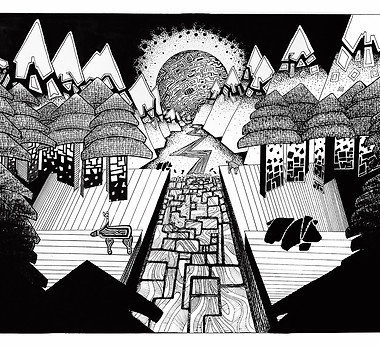
Teaching Portfolio: Deconstruction, Extraction, Interpretation, and Reconstruction: The Planar Form has students revisit their observational drawings from the Negative/Positive Space project and approach them with new eyes. The students deconstruct their earlier work by isolating individual planar forms and then in turn transform them through repetition, overlap, changes in scale, degrees of transparency, movement, balanced compositions and the addition of depth.
Through analysis, manipulation, and reorganization of the extracted forms, students consider ways in which abstracted forms can suggest metaphor, content, and meaning. This new way of organizing and manipulating previously created visual information confirms the recursive nature of our approach to learning, using previously discovered knowledge and transforming it in order to address more complex problems in visual studies.

Teaching Portfolio: Shrine Inventory: Deconstruction and Reconstruction asks students to move from personal experience to metaphor through a sequence of making, observation, and transformation. Students begin by constructing a mixed-media Shrine from objects, images, materials, and other visual information connected to their lives. Working intuitively, they establish a collection of imagery that becomes the source material for further investigation.
Students then study their Shrines through a series of thumbnail compositions, selecting, isolating, combining, and transforming visual information as they develop ideas for a final mixed-media work. Rather than simply reproducing the Shrine, they use it as a springboard for a new composition in which formal decisions about emphasis, color, texture, shape, space, and other elements and principles of design support an independently developed concept. The project brings together skills developed throughout the semester while asking students to transform personal visual information into metaphor and meaning.

Teaching Portfolio: In Contrast of Hue, students explore one of the seven color contrasts of Johannes Itten through digital studies of color, painted color investigations and a final composition exploring how adjacent hues interact to affect issues of brilliance, form, space and visual perception. This project focuses on color as form and explores the initial studies of form made in Contrast of Hue in preparation for the following project, Contrast of Cold and Warm.

Teaching Portfolio:
Understanding Temperature: Students explore the contrast of warm and cool colors through a sequence of digital and physical studies leading to final compositions. Rather than emphasizing target composition, the project challenges students to create smooth chromatic transitions that move gradually from warm to cool. By working with hues of similar or equal brilliance, students develop sensitivity to temperature relationships and discover that a color can appear warmer or cooler depending on the colors surrounding it.
From their previous Contrast of Hue studies, students can use their existing Contrast of Hue compositions as a springboard for their new Contrast of Temperature studies. The student will use the same composition but create new visual effects by changing up the color temperature in order to see how a change in temperature can affect perception of form, space, atmosphere, motion and feeling within a given composition while keeping the overall composition relatively constant.

Teaching Portfolio: Slashing Symbols introduces students to symbolism, iconography, and the ways visual meaning can emerge through an intuitive creative process. Working quickly with imagery, color, and text selected from popular magazines, students create collages without first determining what the finished work will communicate. After making, they examine their choices and consider how repetition, juxtaposition, color, scale, and familiar cultural imagery can generate associations and symbolic meaning.
Positioned between the more formally structured projects and the increasingly independent work that follows, Slashing Symbols asks students to begin using the visual language developed earlier in the course to investigate meaning. Rather than illustrating a predetermined idea, students discover that the process of making itself can reveal unexpected connections and provide a starting point for interpretation, self-expression, and more conceptually driven artmaking.

Teaching Portfolio: Katlin Jeffcoat’s Foundations Curriculum Arc traces her development from observational drawing to sophisticated visual design. Beginning in ARTS 103, she transformed natural forms into structured compositions through studies of shape and texture. In ARTS 107, she deepened this inquiry using Johannes Itten’s color harmony theories to explore how hue and contrast shape perception and emotion.
By ARTS 266, Katlin synthesized these foundations into a cohesive merchandise project—merging craftsmanship, conceptual clarity, and color design rooted in the same perceptual principles that first inspired her work.

Teaching Portfolio: In Quilting Bee, students transform artwork created in earlier artist studies into material for a new visual and conceptual problem. After making high-quality copies of their paintings, students cut the reproductions into one-inch squares and reorganize the fragments within a grid to create a repeat pattern with an anomaly. Marks, textures, shapes, and values are removed from their original context and given new functions through deconstruction, re-contextualization, and reconstruction.
Using their favorite tree as the basis for a metaphor, students move beyond the formal concerns of earlier assignments to consider how visual information can communicate personal meaning. The project demonstrates an important stage in the course: students retrieve knowledge and material from previous work, transform it, and apply it in an increasingly independent conceptual context.

Teaching Portfolio: The course ARTS 107: Color, Technology, and Form teaches students to practice color theory as an active physical method which connects conventional artistic methods to digital artistic techniques. Students use the Adobe Ideas application on their touchscreen device to generate tactile "blobbies" through their body movements and touch pressure. The hand extends through technology to create new artistic possibilities which help students develop analytical skills and intuitive artistic abilities. Students develop their memory skills and perception abilities and creative problem-solving competencies through their work with structured color theory and unrestricted experimental activities. Students achieve complete control of color relationships and create their own visual style while learning to use digital tools with the same care as they would traditional artistic materials by the end of the semester.

