
Dawn Hunter's South Carolina Sunshine


FOUNDATIONS: ARTS 103
Planar Form: From Observation to Abstraction
by Dawn Hunter, Project Author
and ARTS 103 Course Director
The Planar Form Project marks an important transition in ARTS 103 as students move from observation and visual editing toward abstraction, interpretation, and increasingly independent decision-making. Rather than beginning with arbitrary abstract shapes, students return to their earlier Negative/Positive Space drawings and extract enclosed shapes created through the interaction of objects, edges, and negative space. Forms that originated through direct observation are removed from their original context and reconsidered as independent visual elements.
Planar Form. Student example exploring repetition, rhythm, scale, overlap, and movement through the organization of abstract planar forms. Repeated shapes and shifting spatial relationships create a vertically structured composition in which formal elements begin to suggest imagery and metaphor without becoming explicitly representational.

Continued, Planar Form Project:
The extracted enclosed shapes from their Negative/Positive Space drawings are used in the creation of a deck of twenty 4 × 4-inch Planar Form cards that they use to explore a wide array of visual possibilities through thumbnail studies and eventual, more refined, compositions that utilize the same twenty shapes. The focus shifts from attempts to replicate what they had first observed to an investigation of what each shape can do as it is reorganized and recombined. Along the way, students come to realize that the same visual information can be used to create a wide variety of successful solutions, and that the choices one makes as to which information to use, how to select it, how to combine the selected information, how to alter it, and how to employ it within a given composition are all critical.


From Negative/Positive Space to Planar Form. A completed Negative/Positive drawing, left, becomes source material for the next stage of the ARTS 103 curriculum. Students identify and extract enclosed shapes from their drawings to create a vocabulary of abstract planar forms, upper right. A classroom critique, lower right, supports the collaborative process of identifying shapes that can be removed from their original context and reconsidered as independent visual forms.
Why is learning to re-conceptualizing form important?
Learning to re-conceptualize form helps students see that information about visual form is not fixed and can be highly flexible. A form that begins as part of a given object can be ‘retrieved’ and altered to become part of another given object or even become entirely transformed to become part of an entirely abstract composition. In the process of re-conceptualizing form, students move beyond the realm of representation. By using the same formal relationships that the representation uses, students can suggest metaphor, meaning and even content. This ability to retrieve and re-conceptualize prior knowledge is crucial to the student’s development of independent visual thinking.


Student work by Ryan Arambula. Planar Form, Project A, left, and Planar Form, Project B, right. Across the two projects, Arambula transforms abstract planar forms through repetition, rhythm, overlap, transparency, scale, movement, pattern, and spatial depth. The works demonstrate the progression from formal experimentation toward increasingly complex visual content, as abstract forms are re-conceptualized to suggest landscape, environment, movement, and metaphor.
Applying Planar Form Concepts
Building on this formal exercise, students’ consideration of the visual relationships among the repeated, enlarged, and/or overlaid shapes can introduce the subjects of metaphor and content. The various relations of advance and retreat, contraction and expansion, dominance and submission, acceleration and collision, growth and disappearance that are produced by the forms enable a wide range of associations with experience.


Student work by Savannah Jones, Danielle Lass, and Mia Lupinacci. These examples document the development of Planar Form from individual extracted shapes to thumbnail experimentation, collaborative revision, and resolved composition. Savannah Jones’s Planar Form deck establishes a vocabulary of re-conceptualized shapes; her thumbnails and Turning Up the Heat collaboration with Danielle Lass demonstrate how those forms can be repeatedly reorganized and transformed. Mia Lupinacci’s thumbnails and final Planar Form, Project B demonstrate the progression from experimentation toward a resolved composition in which formal relationships begin to establish a distinct visual language and content.
Recursive Curriculum Diagram
Click on the figure to magnify the figure!

A Recursive Model for Foundations Learning model illustrating the original curricular model and conceptual framework developed by Dawn Hunter and applied in her ARTS 103, Fundamentals of Art course.
Applying Planar Form Concepts continued:
Within the larger curriculum of ARTS 103: Foundational Principles, the Planar Form project showcases the kind of recursive learning that keeps students coming back to techniques and observations in new ways. Here, students aren’t simply rehashing their Negative/Positive Space drawings and crude forms, but rather are returning to prior ways of understanding and putting them to use in a novel, increasingly abstract context. That observations of form get translated into shapes, which in turn get transformed into abstract forms and ultimately harbor meaning, is at the heart of the idea of how foundational knowledge can serve a student best: when it can be repeatedly reconsidered, re-adapted, and most importantly, applied independently in novel situations.

ARTS 103 Fundamentals of Art student project display. A selection of student work from sequential Foundations assignments demonstrates the progression from observation and Negative/Positive space to the extraction, transformation, and reorganization of planar forms. Displaying projects together makes visible the relationships between assignments and the recursive development of visual thinking across the course.

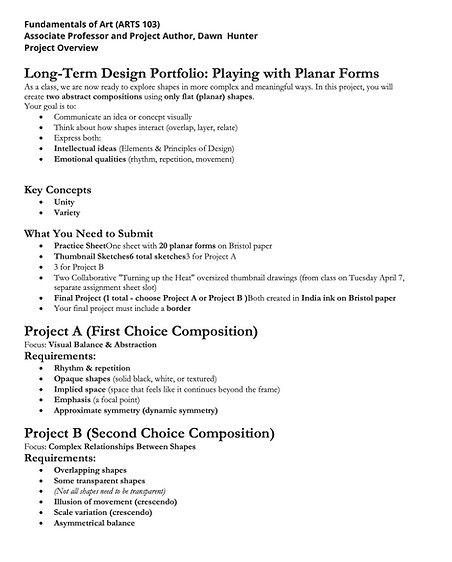
The Assignment Sheets
Click on the assignment for the full page to pop-up!


Above, Planar Form: Turning Up the Heat. Charles Van de Kree and Elissa Myers. This collaborative exercise asks students to exchange compositions and reinterpret a partner’s visual ideas. Repeated organic forms, converging lines, changes in scale, and a strong central axis carry across the two drawings, while each student makes distinct decisions about spatial depth, movement, emphasis, and visual hierarchy.

Conclusion
The Planar Form projects ask students to recognize that visual information is not fixed to the context in which it was first created. Shapes discovered through observation in the Negative/Positive Space project are extracted, re-conceptualized, combined, revised, and ultimately used to construct entirely new visual experiences. Through experimentation, thumbnail development, collaboration, and resolved compositions, students move from applying formal principles toward making increasingly independent choices about metaphor, meaning, and content. In this recursive process, earlier learning becomes material for new discovery: students are not simply learning how to organize form, but how to transform what they already know into new ways of seeing, thinking, and communicating visually.
Student Artwork | Rowyn Dempsey | Planar Form, Project A
Rowyn Dempsey uses repeated opaque planar forms, shifts in scale, and densely crosshatched values to create rhythm, emphasis, and implied spatial depth. The two large groupings establish a dynamic relationship across the composition, while smaller repeated forms move between and around them. Changes in size, placement, repetition, and value create a strong sense of movement while maintaining unity across the composition.